Cyber Threat Intelligence: The Art of Thinking Like the Enemy
A deep technical and strategic guide to Cyber Threat Intelligence — from the lifecycle and MITRE ATT&CK heatmap coverage to IoC enrichment pipelines, cognitive bias in triage, and structured case study analysis of SolarWinds and NotPetya.
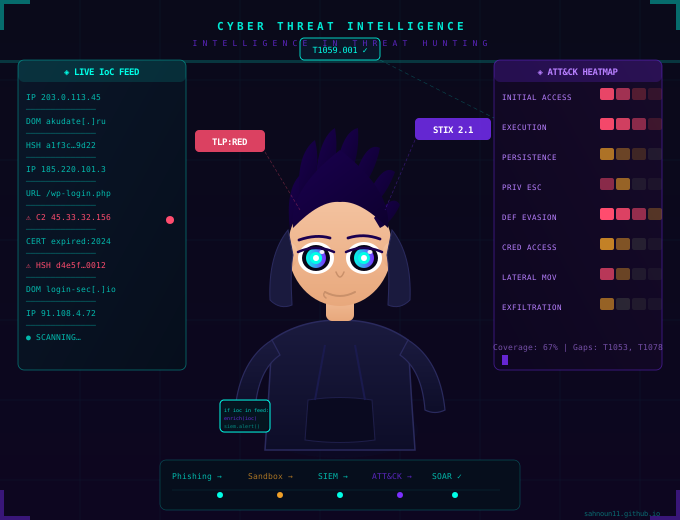
“Intelligence is not knowing everything. It’s knowing what matters, to whom, and when.” — A principle every CTI analyst lives by.
Cyber Threat Intelligence (CTI) is no longer a luxury reserved for nation-states and Fortune 500 companies. In 2025, with global cybercrime costs projected to surpass $10.5 trillion annually (Cybersecurity Ventures, 2023 projection) and ransomware dwell times compressing to under 24 hours in targeted intrusions (Mandiant M-Trends 2024), CTI has become the backbone of every mature security operation.
This post is a deep operational guide — combining structured intelligence tradecraft, real SOC/CTI workflows, MITRE ATT&CK operationalization, and real-world structured case study analysis — into what CTI actually means and how to make it actionable. It is written for SOC Tier 2/3 analysts, CTI practitioners, and threat hunters who want to go beyond theory.
Buckle up. This is a long one.
1. What Is Cyber Threat Intelligence?
At its core, CTI is the collection, processing, analysis, and dissemination of information about potential or existing threats to an organization’s digital assets. The operative word is actionable — raw data is not intelligence.
| Raw Data | Intelligence |
|---|---|
| A list of 10,000 malicious IPs | Those 3 IPs tied to APT28 C2 resolving in your DNS logs right now |
| A malware hash | That hash is Emotet, targeting your sector this week, via T1566.001 |
| A CVE number | CVE-2024-XXXX is actively exploited by TA577 — you have 40 exposed assets |
CTI covers four types of information:
- Indicators of Compromise (IoCs) — digital artifacts: IPs, hashes, domains, URLs, TLS certificates, mutex names
- Tactics, Techniques, and Procedures (TTPs) — how adversaries operate — far more durable than IoCs
- Attribution — who is behind the attack: APT groups, RaaS affiliates, hacktivists, insiders
- Context — the why and so what: geopolitical motivation, industry targeting, campaign timing
Core insight: IoCs expire in hours to days. TTPs persist across years. Build your detection strategy at the TTP layer — it scales. IoC blocking alone does not.
Key Takeaways
- CTI transforms raw data into decision-grade intelligence — if it doesn’t drive a detection, hunt, or decision, it isn’t intelligence yet
- The word actionable is the quality gate for every intel product you produce
- TTPs outlast IoCs by orders of magnitude — prioritize behavioral detection
2. The CTI Lifecycle: Six Stages That Never Stop
The intelligence lifecycle is iterative and continuous — it never truly ends. Missing any stage creates compounding blind spots.
1
2
3
4
5
6
7
  ┌─────────────────────────────────────────────────────────┐
  │                   CTI LIFECYCLE                         │
  │                                                         │
  │  1. DIRECTION → 2. COLLECTION → 3. PROCESSING          │
  │       ↑                                    ↓            │
  │  6. FEEDBACK ← 5. DISSEMINATION ← 4. ANALYSIS          │
  └─────────────────────────────────────────────────────────┘
Stage 1 — Direction (Planning)
Before collecting a single byte, the CTI program must answer: What do we need to know, and why? This is driven by Priority Intelligence Requirements (PIRs) set by leadership.
Key activities:
- Threat modeling and risk assessment aligned to business context
- Defining what “actionable intelligence” means for your specific organization
- Identifying collection gaps against known threat actors in your vertical
- Setting confidence thresholds for escalation
Who owns this: CISO, IR Lead, CTI Lead.
Stage 2 — Collection
Gathering raw data from diverse, layered sources:
| Source Type | Examples | Strength |
|---|---|---|
| OSINT | OTX, VirusTotal, Abuse.ch, GitHub | Free, fast, noisy |
| Government | CISA KEV, NIST NVD, InfraGard | Authoritative, slower |
| ISACs | FS-ISAC, H-ISAC, E-ISAC | Sector-specific, vetted |
| Commercial | Recorded Future, Mandiant, Flashpoint | Curated, enriched, expensive |
| Dark web | Forum scraping, credential leak monitoring | Exclusive, risky to collect |
| Internal | SIEM, EDR, DNS, proxy, honeypots | Highest fidelity for your environment |
Who owns this: CTI Analysts, Threat Hunters.
Stage 3 — Processing & Exploitation
Raw data is noisy, inconsistent, contradictory. This stage normalizes and enriches:
- Format normalization into STIX 2.x for interoperability
- Deduplication and aging/expiration of stale indicators
- Confidence scoring based on source reliability and corroboration count
- Initial triage: is this relevant to our sector? Is it fresh?
Who owns this: Automation Engineers, Intel Technicians.
Stage 4 — Analysis & Production
The intellectual core of CTI. Analysts produce finished intelligence products tailored to each consumer:
- Tactical bulletins — enriched IoC lists with SIEM-ready queries
- Adversary profiles — campaign briefs, ATT&CK heatmaps, actor tracking dossiers
- Threat assessments — risk-ranked summaries for security architects
- Executive briefings — board-level impact framing, no jargon
Who owns this: Intel Analysts, Hunt Team.
Stage 5 — Dissemination
Finished intelligence is only valuable if it reaches the right people, in the right format, at the right time. A 40-page threat report is useless to a SOC analyst triaging at 3 AM.
| Consumer | Format Needed | Delivery Channel |
|---|---|---|
| SOC Analyst | Enriched IoC, Sigma rule | SIEM alert, TIP feed |
| Threat Hunter | Hunt hypothesis, ATT&CK technique | Hunting playbook |
| IR Team | Adversary playbook, attribution note | Incident brief |
| Executive | Risk summary, business impact | PDF briefing, slide deck |
| Partners | STIX package, TLP-labeled | TAXII feed, encrypted email |
Who owns this: CTI Lead, Report Writers.
Stage 6 — Feedback
The lifecycle closes — and immediately reopens — with feedback. Without it, CTI becomes a broadcast, not a program.
Key questions after every cycle:
- Did the intel improve detection speed or reduce MTTD?
- Were there gaps in collection sources or TTP coverage?
- Were confidence assessments accurate after the fact?
- What should change in next cycle’s PIRs?
Who owns this: All stakeholders.
Key Takeaways
- The lifecycle is circular, not linear — feedback is mandatory, not optional
- PIRs are the steering wheel of your CTI program — without them, you collect everything and understand nothing
- Without a feedback loop, you’re running a broadcast service, not an intelligence program
3. The Four Levels of CTI
Intelligence is not one-size-fits-all. Each level serves a distinct audience, time horizon, and decision type. Conflating them is one of the most common CTI program failures.
Strategic CTI
Audience: CISO, Board, Executive Leadership Time horizon: Months to years Question answered: What threats should shape our security strategy and investments?
Examples of strategic CTI products:
- APT41 is shifting toward manufacturing supply chains — does this affect our vendors?
- LockBit 3.0 is targeting financial services in EMEA — should we increase ransomware tabletop frequency?
- Hacktivist activity is increasing around upcoming legislation relevant to our sector
Sources: Government bulletins, commercial threat reports, sector ISACs, intelligence community reports Outputs: Risk assessments, security roadmap inputs, executive briefings, tabletop scenarios
Operational CTI
Audience: Security Managers, IR Leads, Threat Hunt Teams Time horizon: Days to weeks Question answered: What active campaigns are relevant to us, and how are they structured?
Examples:
- Mapping ransomware affiliate C2 infrastructure before a campaign hits
- Building MITRE ATT&CK behavioral profiles for a specific threat group
- Tracking phishing lure evolution across a campaign timeline
Sources: ISAC updates, dark web monitoring, commercial actor tracking, IR case data Outputs: Adversary profiles, campaign briefs, ATT&CK coverage gap maps
Tactical CTI
Audience: SOC Analysts, Detection Engineers Time horizon: Hours to days Question answered: What should we detect and hunt for, right now?
Examples:
- Sigma rules aligned to Emotet’s document macro execution chain
- YARA rules for Cobalt Strike beacon configuration detection
- Hunt hypothesis:
excel.exe→powershell.exeprocess chains matching TA551 profile
Sources: Malware sandbox reports, ThreatConnect, MISP feeds, IR case telemetry Outputs: Sigma/YARA/KQL/SPL detection rules, hunting queries, enriched alert playbooks
Technical CTI
Audience: Malware Analysts, Reverse Engineers Time horizon: Real-time to hours Question answered: What exactly is this artifact doing at a technical level?
Examples:
- SHA-256 hashes for Emotet loader variants
- Network signatures for Cobalt Strike C2 (default beacon config JA3 hash)
- Registry keys and mutex names modified by LockBit pre-encryption
Sources: VirusTotal, MalwareBazaar, Any.run, Joe Sandbox, hybrid-analysis.com Outputs: IoC feeds, YARA/Sigma/Snort rules, malware analysis reports
Key Takeaways
- Don’t conflate levels — a technical IoC dump is not a strategic threat assessment
- Each level needs a different format, different consumer, different time window
- Most CTI failures happen when tactical IoC data is handed to executives without context, or when strategic briefings reach SOC analysts without operationalization
4. MITRE ATT&CK: From Framework to Detection Coverage Map
MITRE ATT&CK is the universal knowledgebase of adversary tactics and techniques observed in real-world attacks. But describing it is not enough — the goal is to operationalize it.
The Framework Structure
ATT&CK organizes into Tactics (adversary goals) and Techniques/Sub-techniques (how they achieve them):
| Tactic | Example Technique | ID | Detectable via |
|---|---|---|---|
| Initial Access | Spearphishing Attachment | T1566.001 | Email gateway, sandbox |
| Execution | PowerShell | T1059.001 | EDR, Sysmon Event 1 |
| Persistence | Scheduled Task | T1053.005 | Sysmon Event 1, WinEvent 4698 |
| Privilege Escalation | Exploit for Priv Esc | T1068 | EDR behavioral anomaly |
| Defense Evasion | LOLBAS (certutil, mshta) | T1218 | Process execution whitelist |
| Credential Access | LSASS Memory (Mimikatz) | T1003.001 | Sysmon Event 10 |
| Lateral Movement | SMB / Admin Shares | T1021.002 | WinEvent 4624, 5140 |
| Collection | Email Collection | T1114 | Exchange logs, O365 audit |
| Exfiltration | Exfil over HTTPS | T1048.002 | Proxy logs, DLP |
| Command & Control | Web Protocols C2 | T1071.001 | DNS, proxy, NetFlow |
Visualizing Your Detection Coverage Gap
The real power of ATT&CK is using ATT&CK Navigator to map your current detection coverage and expose blind spots. A typical mid-maturity SOC might look like this:
1
2
3
4
5
6
7
8
9
10
11
TACTIC            COVERAGE      STATUS
Initial Access    ████████░░    Good  (email gateway + sandbox)
Execution         ████████░░    Good  (EDR + Sysmon)
Persistence       █████░░░░░    Medium (scheduled tasks OK; WMI tasks blind)
Priv Escalation   ████░░░░░░    Medium (kernel exploits blind)
Defense Evasion   ███░░░░░░░    WEAK — LOLBAS largely uncovered
Credential Access ████░░░░░░    Medium (LSASS protected; DCSync blind)
Lateral Movement  ████░░░░░░    Medium (RDP logged; WMI blind)
Collection        ██░░░░░░░░    WEAK — email forwarding rules uncovered
C2                █████░░░░░    Medium (proxy logs; no JA3 fingerprinting)
Exfiltration      ███░░░░░░░    WEAK — encrypted channels not inspected
This heatmap directly drives your detection engineering roadmap. Not “we should improve SIEM,” but specifically: “We have zero coverage for T1047 (WMI execution) and T1036.003 (rename system utilities) — write Sigma rules for those this sprint.”
ATT&CK Navigator Export (Sample JSON Layer)
Save as apt28_coverage.json and import into ATT&CK Navigator:
1
2
3
4
5
6
7
8
9
10
11
12
13
{
  "name": "APT28 Coverage — Q2 2025",
  "versions": {"attack": "14", "navigator": "4.9"},
  "domain": "enterprise-attack",
  "techniques": [
    {"techniqueID": "T1566.001", "score": 100, "comment": "Email gateway + sandbox"},
    {"techniqueID": "T1059.001", "score": 75,  "comment": "EDR — no obfuscation decode"},
    {"techniqueID": "T1003.001", "score": 50,  "comment": "LSASS protected; DCSync blind"},
    {"techniqueID": "T1218",     "score": 20,  "comment": "LOLBAS gap — priority Q3"},
    {"techniqueID": "T1071.001", "score": 60,  "comment": "Proxy logs; no JA3"},
    {"techniqueID": "T1053.005", "score": 80,  "comment": "Sysmon Event 1 + WinEvent 4698"}
  ]
}
Building a Hunt Hypothesis from ATT&CK
“If [actor] is targeting organizations like ours, we might see [technique] in [data source].”
Example for TA551:
“If TA551 delivers Emotet via Excel macros → PowerShell → Cobalt Strike, are there
excel.exespawningpowershell.exeparent-child chains in our EDR, with subsequent outbound connections to non-corporate IPs on port 443?”
- Actor: TA551 (Shathak) — active in financial and manufacturing sectors
- Techniques: T1059.001 (PowerShell) + T1204.002 (malicious file execution)
- Data source: EDR process tree + network connection logs
- Output: Sigma rule + ATT&CK Navigator layer updated
Key Takeaways
- ATT&CK is not a compliance checklist — it is a detection engineering roadmap
- Use ATT&CK Navigator to measure coverage gaps, not just document techniques
- Behavioral detection (TTPs) scales; IoC blocking alone does not
- Every hunt hypothesis should cite at least one technique ID — it makes output trackable and reproducible
5. IoC Enrichment & Correlation: From Data Points to Intelligence
Why Raw IoCs Fail
Without context, an IP address could be legitimate cloud infrastructure, a compromised innocent host, or live adversary C2. The four problems with IoC-only defense:
- No context — what does this indicator mean? To whom is it significant?
- High false positives — shared hosting and CDNs generate massive alert noise
- No prioritization — all IoCs appear equal; none actually are
- No understanding of next move — without TTPs, defenders miss what comes next in the kill chain
The Enrichment Stack
For any IoC, layer these enrichment dimensions:
| Enrichment Layer | Data Point | Tool |
|---|---|---|
| WHOIS | Registrant, creation date, registrar | whois.domaintools.com |
| Passive DNS | Historical resolution records | PassiveTotal, VirusTotal |
| GeoIP / ASN | Country, ISP, hosting provider | ipinfo.io, MaxMind |
| Reputation | VT detections, AbuseIPDB score | VirusTotal, AbuseIPDB |
| Infrastructure | Hosting neighbors, TLS certificate reuse | Shodan, Censys, RiskIQ |
| Malware family | Sandbox detonation output | Any.run, Joe Sandbox |
| Actor attribution | Known actor infrastructure overlap | Recorded Future, Mandiant |
Five Correlation Techniques
1. Exact Matching — Direct IoC-to-feed comparison. The baseline — automated in most SIEMs and TIPs.
2. Infrastructure Pivoting — Use one IoC to discover related indicators. A malicious domain → IP → five more domains on same IP → same WHOIS registrant email → twelve more actor-linked domains. You started with one indicator; you end with a map of actor infrastructure. Tools: PassiveTotal, Shodan, Censys
3. Fuzzy Matching — Detect typosquatting and near-identical malware variants.
dropb0x-secure[.]comvs.dropbox[.]com- Malware hashes with 93% ssdeep similarity (different compiler build, same codebase) Tools: ssdeep, YARA with fuzzy modules
4. Time-Based Correlation — Reconstruct attack timelines by correlating IoCs across log sources by timestamp:
1
2
3
4
5
10:03:14 — Email Gateway: attachment hash a1b2c3…  → MATCH: Emotet (TA542)
10:05:02 — DNS Query:     login-secure[.]com       → MATCH: known TA542 C2 domain
10:05:45 — EDR:           excel.exe → powershell.exe -enc <base64>
10:06:12 — Proxy:         POST 203.0.113.25:443    → MATCH: threat feed C2 beacon
10:07:30 — EDR:           powershell.exe → cmd.exe → net user /add backdoor
This four-minute window reconstructs: Phishing → Emotet download → PowerShell → C2 beacon → Persistence attempt. One enriched alert becomes a complete kill chain.
5. TTP and Campaign Linking — Match IoC behavior to known techniques and actor profiles. PowerShell with base64 encoding + AMSI bypass → T1059.001 + T1562.001. Infrastructure overlapping with APT28 Q3 campaign. This is the highest-value correlation: linking a technical artifact to an adversary with known intent and documented next moves.
A Real Enrichment Scenario
SIEM Alert: Outbound connection to 34.117.59.81
| Step | Finding |
|---|---|
| WHOIS | Google Cloud (GCP) — commonly abused for C2 masquerading as cloud traffic |
| GreyNoise | Seen scanning SSH globally — opportunistic noise, not specifically targeted |
| VirusTotal | 3/94 engines flagged — low signature coverage |
| Passive DNS | Previously resolved from akudate.evilcorp[.]com |
| Sandbox detonation | Domain dropped Emotet loader (SHA256: d4e5f…0012) |
| Actor attribution | Infrastructure matches TA542 (Emotet) Q1 2025 campaign cluster |
| ATT&CK | T1071.001 (C2 over HTTPS), T1566.001 (initial phishing vector) |
Result: A low-confidence cloud-IP alert becomes a confirmed, attributed, campaign-linked C2 connection — with a known TTP chain, a known actor, and a known next move (Cobalt Strike second-stage based on Emotet’s documented playbook).
Automated response triggered: Firewall block → SOAR playbook → lateral movement hunt launched → FS-ISAC notification prepared.
Key Takeaways
- Enrichment converts a data point into a decision — it is the ROI of your threat intelligence investment
- Time-based correlation is the most underused technique — it reconstructs kill chains from disparate log sources
- Infrastructure pivoting often finds more actors than you started looking for — treat it as reconnaissance of the adversary’s footprint
6. CTI Integration into Your Defense Stack
CTI is only as valuable as its integration. A threat report sitting in a SharePoint PDF helps no one.
The Integrated Stack
1
2
3
4
5
6
7
8
9
10
11
12
13
14
15
16
17
18
19
20
21
┌─────────────────────────────────────────────────────┐
│              INTELLIGENCE SOURCES                   │
│   OSINT   Commercial   ISACs   Dark Web   Internal  │
└──────────────────────┬──────────────────────────────┘
                       ↓
┌──────────────────────────────────────────────────────┐
│   TIP (MISP / ThreatConnect / Anomali / OpenCTI)     │
│   Normalizes · Enriches · Distributes · Ages out     │
└────────┬─────────────────┬──────────────┬────────────┘
         ↓                 ↓              ↓
    ┌─────────┐       ┌─────────┐   ┌──────────┐
    │  SIEM   │       │   EDR   │   │ Firewall │
    │Splunk / │       │Falcon / │   │ / WAF    │
    │Sentinel │       │S1 / MDE │   │ Auto-blk │
    └────┬────┘       └────┬────┘   └──────────┘
         └─────────┬───────┘
                   ↓
    ┌──────────────────────────────┐
    │   SOAR (XSOAR / Splunk SOAR) │
    │   Automated Response Playbooks│
    └──────────────────────────────┘
Detection Logic: Before vs. After CTI
Without CTI:
1
src_ip="203.0.113.45" | alert
With CTI:
1
2
3
4
5
6
7
8
| inputlookup threat_feed.csv
| where confidence >= 70
  AND last_seen >= relative_time(now(), "-7d@d")
  AND NOT cidrmatch("10.0.0.0/8", src_ip)
| join src_ip [search index=network]
| eval context = actor + " | " + campaign + " | " + ttp
| table _time, src_ip, dest_ip, context, confidence
| alert priority=high
The CTI-enriched rule generates fewer false positives, provides immediate triage context, ties the alert to actor and campaign, and powers a SOAR response — all from a single enriched lookup.
The Full Detection Workflow
1
2
3
4
5
6
7
8
9
10
11
12
13
14
15
PHISHING EMAIL received
        ↓
EMAIL GATEWAY flags attachment → sandbox triggered
        ↓
SANDBOX detonates → hash + C2 domain extracted → pushed to TIP
        ↓
TIP enriches → matches TA542 Emotet Q2 2025 campaign
        ↓
SIEM alert fires with context: ATT&CK T1566.001 + T1071.001 mapped
        ↓
SOAR playbook: block IP → isolate host → notify IR team → open ticket
        ↓
HUNT triggered: search 30-day EDR for other Excel → PowerShell chains
        ↓
FEEDBACK: new Sigma rule committed → ATT&CK Navigator layer updated
This is CTI fully operationalized: not a threat report, but a closed-loop detection and response pipeline powered by intelligence at every step.
CTI Maturity Model
| Level | Capability | Typical Profile |
|---|---|---|
| 1 | Ad hoc IoC lookup, reactive only | No CTI function, small IT team |
| 2 | Automated IoC ingestion into SIEM | Small SOC, basic TIP |
| 3 | Detection rule tuning with ATT&CK alignment | SOC + Security Engineering |
| 4 | Behavioral analytics, hypothesis-driven hunting | CTI + dedicated Hunt team |
| 5 | Closed-loop SOAR response + continuous PIR feedback | Mature CTI program |
Most organizations are at Level 2–3. Level 5 requires aligned people, process, and technology — and a culture of measurement, not estimation.
Key Takeaways
- CTI without SIEM/SOAR integration is a library, not a defense system
- The detection workflow (Phishing → Sandbox → SIEM → ATT&CK → SOAR → Hunt → Feedback) is the minimum viable CTI pipeline
- Measure your program by MTTD reduction, false positive rate, and ATT&CK coverage — not by volume of IoCs ingested
7. Intelligence-Driven Threat Hunting
The most powerful application of CTI is proactive threat hunting — actively searching for adversary activity that has not triggered an alert.
From Reactive to Intelligence-Driven
| Feature | Traditional Hunting | Intelligence-Driven |
|---|---|---|
| Scope | Broad, unfocused | Scoped to specific actors and TTPs |
| Driver | Gut feeling, anomalies | Adversary behavioral profiles from CTI |
| Hypothesis | Vague (“look for weird things”) | Specific (“look for T1053.005 in Windows event logs”) |
| Outputs | Potential anomalies | Detections, new Sigma rules, actor confirmation |
| Efficiency | Variable, often low | High — defined expected findings |
A Worked Hunt: TA551 (Shathak)
Intel trigger: TA551 is actively targeting financial sector organizations using Excel macro delivery → RDP → Cobalt Strike chain.
Hypothesis:
“If TA551 delivered Emotet via Excel macros to users in our environment last week, we should see
excel.exespawningcmd.exeorpowershell.exe, followed by outbound connections to non-corporate IPs on port 443.”
ATT&CK mapping:
- T1204.002 — User Execution (malicious Office document)
- T1059.001 — PowerShell execution
- T1219 — Remote Access Software (Cobalt Strike)
Hunt query (KQL for Microsoft Sentinel):
1
2
3
4
5
6
7
8
9
10
11
DeviceProcessEvents
| where InitiatingProcessFileName == "excel.exe"
  and FileName in ("powershell.exe", "cmd.exe", "wscript.exe")
  and Timestamp > ago(7d)
| join kind=inner (
    DeviceNetworkEvents
    | where RemotePort == 443
      and not(ipv4_is_private(RemoteIP))
  ) on DeviceId
| project Timestamp, DeviceName, FileName, ProcessCommandLine, RemoteIP
| sort by Timestamp desc
Possible hunt outputs:
- No positives found → document as “hunted negative,” mark T1059.001 as hunted in ATT&CK Navigator layer
- Positive found → confirm C2, isolate host, create Sigma rule, enrich TIP, prepare ISAC notification
Key Takeaways
- Hunt hypotheses must be falsifiable — define what a positive and negative look like before you start
- Every hunt must produce an output: new rule, confirmed negative, or actor profile update
- Document negatives as rigorously as positives — they prove coverage and reduce redundant future hunts
8. STIX, TAXII, and TLP: The Language of Sharing
STIX 2.1 — What Is Shared
STIX is the JSON-based data format for representing threat intelligence objects and their relationships:
1
2
3
4
5
6
7
8
9
10
11
12
13
14
{
  "type": "indicator",
  "spec_version": "2.1",
  "id": "indicator--d81f86b9-975b-4c0b-875e-810c5ad45a4f",
  "name": "Emotet C2 IP — TA542 Q2 2025",
  "pattern": "[ipv4-addr:value = '203.0.113.45']",
  "pattern_type": "stix",
  "valid_from": "2025-05-01T00:00:00Z",
  "confidence": 85,
  "labels": ["malicious-activity"],
  "external_references": [
    {"source_name": "MITRE ATT&CK", "external_id": "T1071.001"}
  ]
}
Key STIX object types: Threat Actor, Malware, Tool, Campaign, Attack Pattern, Indicator, Relationship, Course of Action.
TAXII 2.1 — How It’s Shared
TAXII is the transport protocol — a RESTful HTTP/S API that moves STIX data between platforms in real time. Intelligence is organized into topic-based Collections (e.g., FS-ISAC-Ransomware-Feed). Clients push and pull STIX bundles programmatically.
TLP — Who Sees It
| Label | Distribution |
|---|---|
| 🔴 TLP:RED | Named recipients only — do not share beyond them |
| 🟠 TLP:AMBER | Limit to need-to-know within your org and trusted partners |
| 🟢 TLP:GREEN | Share within your community (ISACs, sector peers) |
| ⬜ TLP:CLEAR | No restrictions — publicly shareable |
SolarWinds SUNBURST example: IoC package started TLP:RED (named government recipients) → TLP:AMBER (vetted critical infrastructure operators) → TLP:CLEAR (public GitHub release, three weeks later).
The trilogy in one sentence: STIX = what is shared. TAXII = how it moves. TLP = who can receive it.
Key Takeaways
- Without STIX/TAXII/TLP, sharing is ad hoc, inconsistent, and unscalable
- TLP:AMBER is the most misapplied label — organizations routinely over-restrict (RED) or under-restrict (GREEN) operational intelligence
- Automate STIX ingestion into your TIP — manual IoC copy-paste is a 2015 workflow
9. Intelligence Sources: OSINT, Commercial, Closed
OSINT
Strengths: Free, fast, community-driven, real-time signals Weaknesses: High noise, often unverified, susceptible to adversary seeding/poisoning
Key sources: AlienVault OTX, VirusTotal, MalwareBazaar, Abuse.ch, Shodan, Censys, Twitter/X (threat actor tracking), GitHub (PoC drops, IoC repos)
Anti-pattern to avoid: Ingesting raw OTX pulses directly into SIEM without validation. You will block legitimate infrastructure within 24 hours and spend the next two days fielding calls from the business.
Commercial Feeds
Strengths: Curated, enriched, vetted, SLA-backed, SIEM/TIP integrated, actor tracking Weaknesses: Expensive; risk of “vendor echo chamber” where all customers see the same indicators at the same time
Key providers: Recorded Future, Mandiant (Google), Flashpoint, Palo Alto Unit 42, CrowdStrike Falcon X, Secureworks CTU
Anti-pattern to avoid: Buying a feed and never tuning it to your industry and threat profile. Irrelevant indicators at scale are indistinguishable from noise.
Closed Sources
Strengths: Exclusive, high-confidence, early warning, often government-derived Weaknesses: Access is earned, not purchased; limited transparency into collection methodology
Key sources: CISA Alerts & Advisories, NSA Cybersecurity Directorate, FBI Flash alerts, InfraGard, sector ISACs (vetted member tier)
The Multi-Source Advantage
No single source is sufficient. The signal emerges from cross-tier correlation:
- OSINT detects a new phishing domain → fast, noisy, unverified
- Commercial feed matches the infrastructure to a known APT → structured, expert context
- Closed source / ISAC confirms the campaign is actively targeting your sector → strategic, high-confidence
Speed + Structure + Strategy = Resilience
Key Takeaways
- OSINT is the loudest source and the least reliable — always validate before ingesting into production
- Commercial feeds are only as good as your tuning — irrelevant intelligence is indistinguishable from noise
- ISACs are the most underused resource in mid-market security programs — join your sector ISAC
10. Cognitive Bias: The Hidden Enemy of CTI Analysis
Even the most technically skilled analyst can be undermined by cognitive bias. This is not theoretical. Bias directly causes alert triage errors, missed escalations, mis-attribution, and false-positive escalation cycles in real SOC environments every day.
Seven Biases and Their SOC Consequences
1. Confirmation Bias What it is: Favoring evidence that confirms existing beliefs; ignoring disconfirming data. SOC consequence: An analyst convinced an alert is a false positive stops enriching it. The true positive goes unescalated. Dwell time grows. Real example: “This looks like our usual admin PowerShell scripts” — analyst closes the ticket. Misses a Cobalt Strike beacon using the same parent process as legitimate tooling. Mitigation: Analysis of Competing Hypotheses (ACH) — explicitly build and evaluate the disconfirming hypothesis before closing any ticket.
2. Anchoring Bias What it is: Over-relying on the first piece of information received; all subsequent analysis is anchored to it. SOC consequence: First responder categorizes an incident as “phishing.” All subsequent analysis anchors to that label, even as evidence of supply chain compromise emerges. Real example: NotPetya initially anchored as ransomware — correct classification as a destructive wiper came days later, after critical response time was wasted. Mitigation: Key Assumptions Check at each phase transition: “What assumption am I making that could be wrong?”
3. Mirror Imaging What it is: Assuming adversaries prioritize and think the way defenders do. SOC consequence: Defenders model attacks based on their own logical paths, missing actual adversary creativity. Classic example: assuming attackers want money, therefore missing a nation-state wiper. Mitigation: Red Team Analysis — assign someone to actively think as the adversary, not as a defender.
4. Availability Bias What it is: Over-weighting recent, vivid, or easily recalled events. SOC consequence: After a Cobalt Strike incident, every process injection alert is escalated. Meanwhile, a stealthy LOLBAS attack using certutil for payload delivery goes uninvestigated. Mitigation: Maintain threat actor tracking beyond 90 days. Run historical baseline analysis, not just recent incident pattern matching.
5. Groupthink What it is: Conforming to team consensus; suppressing personal dissent. SOC consequence: Senior analyst says “false positive” — junior analysts close the ticket without verification. True positive closed incorrectly. Mitigation: Devil’s Advocacy — create a culture where challenging an assessment is explicitly rewarded. Structured escalation paths that don’t require social courage to use.
6. Satisficing What it is: Stopping at the first “good enough” answer instead of exploring alternatives. SOC consequence: Analyst finds one malicious IoC and closes the investigation. Does not pivot to related infrastructure, does not look for lateral movement. Mitigation: Define minimum enrichment standards per alert tier. “Investigation closed” requires N correlation steps, not just a single hit.
7. Overconfidence What it is: Overestimating the accuracy or completeness of your own analysis. SOC consequence: “We have 95% detection coverage” stated without measurement creates false assurance. Blind spots go unexamined. Mitigation: ATT&CK Navigator coverage mapping. Measure detection coverage; never estimate it.
Structured Analytical Techniques (SATs)
| Technique | Best Used When |
|---|---|
| Analysis of Competing Hypotheses (ACH) | Attribution decisions; mis-categorization risk is high |
| Key Assumptions Check | Starting any new investigation or threat assessment |
| Red Team Analysis | Threat modeling; adversary simulation planning |
| Devil’s Advocacy | Team consensus has formed — stress-test it |
| Timeline Mapping | Reconstructing attack chains; correlating across log sources |
| Link Analysis | Connecting people, infrastructure, malware, and events visually |
Key Takeaways
- Cognitive bias causes real SOC failures — this is operational risk management, not academic theory
- Satisficing is the most dangerous bias in SOC work — investigations closed too early are the leading cause of extended dwell time
- ACH and Key Assumptions Check are the highest-ROI SATs for daily CTI and SOC work
- Build a team culture where dissent is safe — a junior analyst who re-escalates a closed ticket should be praised, not dismissed
11. ISACs: The Power of Collective Defense
Information Sharing and Analysis Centers (ISACs) are non-profit, member-driven organizations that facilitate sector-specific CTI sharing. They are the closest thing to a collective immune system that cybersecurity has produced — and they are chronically underused by mid-market organizations.
Major ISACs by Sector
| Sector | ISAC |
|---|---|
| Financial Services | FS-ISAC — fsisac.com |
| Healthcare | H-ISAC — h-isac.org |
| Energy | E-ISAC — eisac.com |
| Information Technology | IT-ISAC — it-isac.org |
| Aviation | A-ISAC — a-isac.com |
| Automotive | Auto-ISAC — automotiveisac.com |
| Multi-State Government | MS-ISAC — cisecurity.org |
The Sharing Mechanism
- Members submit threat observations, incidents, and IoCs (anonymized or attributed at their discretion)
- ISAC analysts enrich and contextualize submissions
- Intelligence is redistributed as STIX packages over TAXII, TLP-labeled
- Members ingest directly into SIEMs, TIPs, and SOAR platforms
- Critical intelligence is escalated to CISA/FBI/NSA for government coordination
Public-Private Coordination
ISACs coordinate intelligence with:
- CISA — alert dissemination, KEV catalog, Shields Up notifications
- NSA Cybersecurity Directorate — classified threat briefings for critical infrastructure
- FBI InfraGard — law enforcement intelligence on criminal threat actors
- USSS Cyber Fraud Task Forces — financial cybercrime investigations
Key Takeaways
- ISACs are the most underused resource in mid-market cybersecurity — membership is often more affordable than a single commercial feed
- The value compounds: every member who shares makes the intelligence better for every other member
- ISAC sharing operates under TLP — you control what gets shared and with whom
12. Case Studies: CTI in the Real World
These are not just stories. Each case is analyzed in structured intelligence format: what CTI got right, what it failed to detect early, the detection lesson, and the prevention lesson.
Case Study 1: SolarWinds SUNBURST (2020)
Background: The SolarWinds Orion platform — used by 18,000+ organizations including major US government agencies — was compromised via a supply chain attack. A backdoor called SUNBURST was embedded into a trojanized software update and went undetected for approximately 9 months.
Threat Actor: APT29 / Cozy Bear (Russian SVR) Known for: extreme patience, months-long dwell times, strong OPSEC, living-off-the-land techniques.
Attack Timeline:
| Date | Event |
|---|---|
| Sep 2019 | Initial access to SolarWinds build environment |
| Oct 2019 | SUNBURST testing begins inside build pipeline |
| Feb 2020 | Trojanized Orion DLL compiled and signed |
| Mar 2020 | Malicious update pushed to 18,000+ customers |
| May–Jun 2020 | Active exploitation of select high-value targets |
| Dec 8, 2020 | FireEye discovers breach during their own IR investigation |
| Dec 13, 2020 | Public disclosure — CISA Emergency Directive 21-01 |
TTPs Observed:
| Technique | ID | Notes |
|---|---|---|
| Supply Chain Compromise | T1195.002 | Build environment compromised — signed by SolarWinds |
| SAML Token Forgery | T1606.002 | “Golden SAML” — bypassed MFA across identity providers |
| Valid Accounts | T1078 | Legitimate admin credentials used throughout |
| LOLBAS | T1218 | Windows management tools used to evade AV |
| C2 over HTTPS | T1071.001 | Disguised as legitimate Orion telemetry traffic |
| Timestomping | T1070.006 | File metadata modified to evade forensic timelines |
Structured CTI Analysis:
What CTI got right: After disclosure, community sharing was rapid and effective. STIX packages distributed from TLP:RED → TLP:CLEAR within three weeks. FireEye, Microsoft, CISA, and Volexity all contributed IoC sets and behavioral signatures. ATT&CK mapping of SUNBURST behavior was completed within 48 hours of public disclosure, enabling rapid detection rule development.
What CTI failed to detect early: No collection source detected the supply chain compromise during the 9-month window. OSINT had no signal. Commercial feeds had no actor intelligence on the build environment intrusion. The attack was specifically designed to defeat IoC-based defenses — the backdoor was cryptographically signed by SolarWinds itself, making hash and signature-based detection irrelevant.
Detection lesson: Behavioral analytics on identity telemetry — unusual SAML token issuance patterns, impossible travel in admin accounts, service accounts accessing unusual resources — would have been the most viable detection vector. The attack defeated IoC-based detection by design. Defender success required questioning vendor trust and monitoring identity plane anomalies, not just malware signatures.
Prevention lesson: Software supply chain security must be an explicit CTI collection requirement. Vendor trust models need defined threat profiles. Build environment integrity monitoring and code signing certificate anomaly detection must be part of any mature CTI program’s PIRs.
Case Study 2: NotPetya (2017)
Background: In June 2017, a cyberattack spread from Ukraine via the MeDoc accounting software update mechanism, rapidly impacting multinational organizations globally. It presented as ransomware — demanded a Bitcoin payment — but the decryption mechanism was non-functional by design. NotPetya was a destructive wiper masquerading as ransomware.
Threat Actor: Sandworm (Russian GRU) Known for: destructive operations against critical infrastructure, prior Ukrainian power grid attacks (2015, 2016).
Attack Timeline:
| Date | Event |
|---|---|
| Jun 27, 2017 | MeDoc update delivers NotPetya to Ukrainian organizations |
| Jun 27 +2h | EternalBlue/EternalRomance propagation to global networks |
| Jun 27–28 | Maersk, FedEx (TNT), Merck, Saint-Gobain all impacted |
| Jun 28 | First correct attribution: GRU/Sandworm (not criminal RaaS) |
| Dec 2017 | US/UK governments formally attribute to Russian GRU |
TTPs Observed:
| Technique | ID | Notes |
|---|---|---|
| Supply Chain Compromise | T1195.002 | MeDoc software update vector |
| Exploit Public Application | T1190 | EternalBlue (MS17-010) + EternalRomance propagation |
| Credential Dumping | T1003 | Mimikatz to harvest domain credentials |
| Lateral Movement via SMB | T1021.002 | PsExec with harvested credentials |
| MBR Overwrite | T1561.002 | Master Boot Record destroyed — unrecoverable |
| Fake Ransomware | T1491 | BTC payment address; broken decryption key by design |
Structured CTI Analysis:
What CTI got right: Technical malware analysis was rapid. Within 24 hours, researchers identified EternalBlue as the propagation mechanism, Mimikatz for credential harvesting, and PsExec for lateral movement. Malware samples were shared quickly across the research community and correctly mapped to the ATT&CK framework.
What CTI failed to detect early: The strategic intent was missed. CTI initially classified NotPetya as ransomware — financially motivated criminal activity. This caused a critical response error: victim organizations spent hours attempting to recover decryption keys and prepare ransom payments. The lack of geopolitical context in the technical CTI analysis delayed the correct understanding that this was a destructive, politically motivated nation-state operation where no recovery from encrypted drives was possible.
Detection lesson: Strategic CTI context is indispensable for correct response posture. Ransomware (intent: extort) and a wiper (intent: destroy) require fundamentally different responses: ransomware → preserve evidence, evaluate ransom decision, negotiate; wiper → full BCP activation immediately, no recovery from encrypted drives, focus entirely on clean rebuild. The technical fingerprint may look similar; the response must not.
Prevention lesson: MS17-010 (EternalBlue) had been patched for months before NotPetya — the majority of impacted organizations had not applied it. Network segmentation would have significantly limited propagation. The Maersk recovery from a single untouched Ghana domain controller illustrates the absolute criticality of offline, geographically distributed backups.
Impact: Maersk (~$300M), FedEx/TNT (~$400M), Merck (~$870M), Saint-Gobain (~$384M). Total estimated damages: ~$10 billion (White House attribution statement, February 2018).
Key Takeaways
- Attribution is not just “whodunnit” — understanding adversary intent changes every decision in the first 30 minutes of response
- Supply chain compromise defeats IoC-based detection by design — identity and behavioral telemetry are the essential complements
- Strategic CTI context saves time in crisis — the faster you correctly classify an attack, the better every subsequent decision becomes
13. The 2025 CTI Landscape
The CTI field is evolving rapidly. Key trends grounded in available primary research:
- AI-assisted analysis is growing fast — platforms like Recorded Future and Google Threat Intelligence use LLMs to summarize threat actor profiles and correlate indicators at scale (SANS CTI Survey 2024)
- 52% of organizations reported a dedicated CTI function in 2024, up from ~30% in 2020 (SANS CTI Survey 2024)
- 75% of mature CTI teams use threat intelligence for proactive hunting, not just reactive indicator blocking (SANS CTI Survey 2024)
- Mastercard’s ~$2.65B acquisition of Recorded Future (2024) signals CTI is now a board-level strategic asset
- CISA KEV catalog has become a de facto triage standard — CVEs on the KEV list are confirmed in-the-wild exploited, making them automatic P1 patching priorities regardless of CVSS score
- External Attack Surface Management (EASM) is converging with CTI — understanding what adversaries can see about your organization is the natural extension of understanding who they are
Sourcing note: Percentage statistics in CTI industry reports vary significantly by vendor and methodology. Treat aggregate claims as directional signals, not precise measurements. Primary sources for this section: SANS CTI Survey 2024, Verizon DBIR 2024, ENISA Threat Landscape 2024, Mandiant M-Trends 2024.
14. Conclusion: Don’t Just Collect — Operationalize
CTI is not about having the most indicators, the most feeds, or the most expensive platform. It is about transforming data into understanding, and understanding into action.
Six principles that separate mature CTI programs from ineffective ones:
- Quality over quantity — a handful of high-confidence, relevant, enriched IoCs beats 10 million stale hashes
- Behavior over indicators — TTPs persist where hashes and IPs rotate; build detections at the behavior layer
- Context over alerts — raw alerts are noise; intelligence-enriched alerts are decisions waiting to be made
- Sharing over hoarding — adversaries share tactics, infrastructure, and tooling; defenders must share too
- Feedback over silos — CTI without feedback loops is a broadcast, not a program
- People, process, and technology — no tool replaces analytical tradecraft, structured thinking, and domain expertise
The adversary is not standing still. They are adapting, sharing, and operationalizing their own intelligence about your defenses. The only viable response is to outthink them — with better intelligence, better analysis, and better collaboration.
Keep your brain open. Think critically. Resist your own biases. Connect the dots.
And make your intelligence actionable.
References & Further Reading
Frameworks & Standards
- MITRE ATT&CK Framework
- ATT&CK Navigator
- STIX/TAXII Standards — OASIS
- FIRST Traffic Light Protocol (TLP)
Threat Feeds & Platforms
- CISA Known Exploited Vulnerabilities (KEV)
- AlienVault OTX
- MalwareBazaar — Abuse.ch
- OpenCTI Platform
- MISP Project
Primary Research
Case Study Sources
- Mandiant — SolarWinds SUNBURST (UNC2452)
- CISA Emergency Directive 21-01
- Wired — The Untold Story of NotPetya
Books
- Intelligence-Driven Incident Response — Scott J. Roberts & Rebekah Brown (O’Reilly)
- The Threat Intelligence Handbook — CrowdStrike
- Structured Analytic Techniques for Intelligence Analysis — Heuer & Pherson
Written by Sahnoun — Blue Team Practitioner & CTI Analyst. Feedback, corrections, and additions are always welcome — open an issue or PR on GitHub.